Shoot my mouth off: On Maggie Nelson’s Pathemata, or, the story of my mouth and growing up
When I finished reading the assigned work of Maggie Nelson from Peter Mountford’s class The Problem of Literary Theory, taken to fill my literary theory requirement in the UNR-Lake Tahoe Low Res MFA program, I was agitated. The excerpt was another example of a cisgendered human writing about their experiences with a transperson and while honest, came off as gender tourism. She states to her queer lover winning her over that “the words I love you come tumbling out of my mouth in an incantation the first time you fuck me in the ass, my face smashed against the cement floor of your dank and charming bachelor pad.” is supposed to be subversive (?) I guess. But this glib dialog about anal sex right off the cuff comes off crude rather than brilliant. If the narrative is meant to be queer coded, then a reader might assume that anal sex is a way to define queerness. That’s entirely not true. Second, anal sex as a metaphor for subversiveness was outdated even in 2015. Queer bodies and sex are no longer and should no longer be needed to challenge the status quo.
I was so irritated, in fact, that I went out and bought The Argonauts, the book length essay Nelson wrote in which the section Mountford pulled from was sourced. And as I continued to rage against the work, I found myself returning, over and over again to her arguments, her narrative structure, and how it all worked. I had to admit, though I was still agitated at the deconstruction of gender queerness through the experiences of a cisgendered person, Nelson was doing with form what I want to do in my writing. Nelson could teach me.
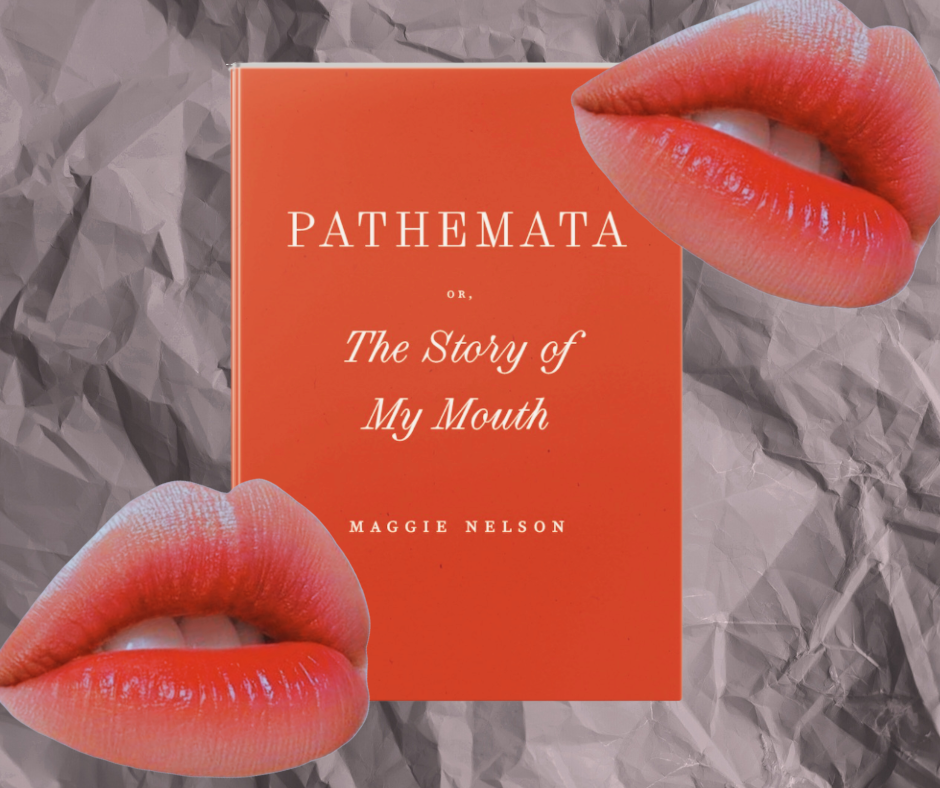
I am working towards my thesis project for my time here at UNR-Lake Tahoe, discovering a story I wanted to tell about a character who has a cleft palette, inspired by my own experiences. To bring my character to life, a larger perspective than my own was necessary. I looked to what the world of literature had to offer on maxillofacial deformities. There in the ether lay Pathemata, or, The Story of My Mouth, Nelson’s essay in poetry form released in 2025 by Wave Books. Nelson offered a lighthouse into a shared psychology of mouth pain, mouth trauma, and navigating the world of medicine and scarcely finding answers.
The main narrative captures Nelson’s trip through the hotfire hell hoops of healthcare affairs. She visits row after row of doctors promising cures by offering antidotes and contraptions far worse and far more expensive and intrusive than that of the average snake oil salesman. One such doctor suggests she undergo a frenectomy, a viscous word that sounds like castration, dissection, and vivisection. True to Nelson’s style she punctuates the quest for healing with the surrounding mundane activities of life, like when "watching the waiter refill [her] sparkling water from a cobalt bottle” moves her to tears. None of the anecdotes she includes act as subterfuge, but to elicit the constant state of discomfort that occupies every moment we are expected to be as a whole person while an underlying pain persists.
Nelson’s mouth, subject to constant nagging sensations, is a passageway that consumes and exhales while the tender flesh, protruded by enamel teeth, is bothered by a growing tongue that throbs and aches. All the while, the entire passageway that ingests and exhales is the source of struggle for her entire psyche. A body continually disrupted.
Alongside her central body narrative, Nelson blends in her dreams and feverish visions; half documentary and half projection of the body suffering as she sleeps. The images of sex, death, trauma, and fear manifest as messages sent through the nervous system to an overactive brain trying to find some relief. “The pain keeps demanding an answer,” she proclaims, and the search for an answer of what’s causing her to suffer is an obsession accompanied by anger. Anger, fear, obsession, insecurity all stacked up on top of pain.
Nelson’s real life quest of doctor visits, phone calls, and questionable practices is transformed into the desire to give up, to give in. But as she notes, surrender is impossible because “pain pretends urgency; one has to become coldhearted to its entreaties”. Therefore, she suggests, we must tell. Thus, I have found the true common ground her essays have always hinted at for me.
Though we are writers who have faced unending discomfort in such an intimate part of our bodies, we both understand that it’s not the story that matters, not the details, or the language. The catharsis is in the telling at all, the struggle in mouthing the words we were forced to correct as children. That has value—to embrace our vulnerability and let go.
Pathemata, or, The Story of My Mouth by Maggie Nelson is available from Wave Books
“True to Nelson’s style she punctuates the quest for healing with the surrounding mundane activities of life, like when “watching the waiter refill [her] sparkling water from a cobalt bottle” moves her to tears. None of the anecdotes she includes act as subterfuge, but to elicit the constant state of discomfort that occupies every moment we are expected to be as a whole person while an underlying pain persists. ”