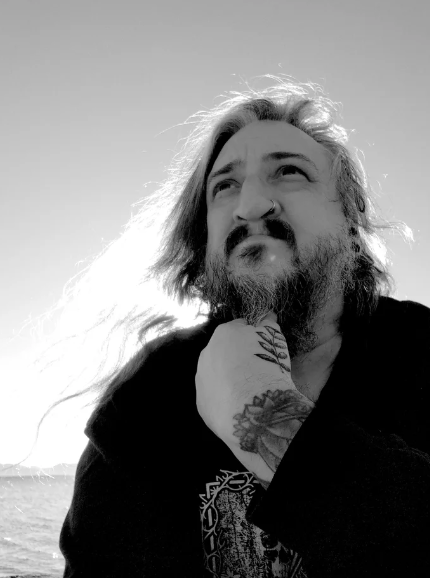
SNR interviews: Adam Gnade
“It’s just like going out and seeing the country. You want to know what your people are doing and what they’re thinking and what they love and what they hate, what they’re afraid of. And I think I feel it very satisfying being involved in literature because you’ve got this whole wall of ghosts behind you that you can visit all the time, and one day you’ll be one of them.”
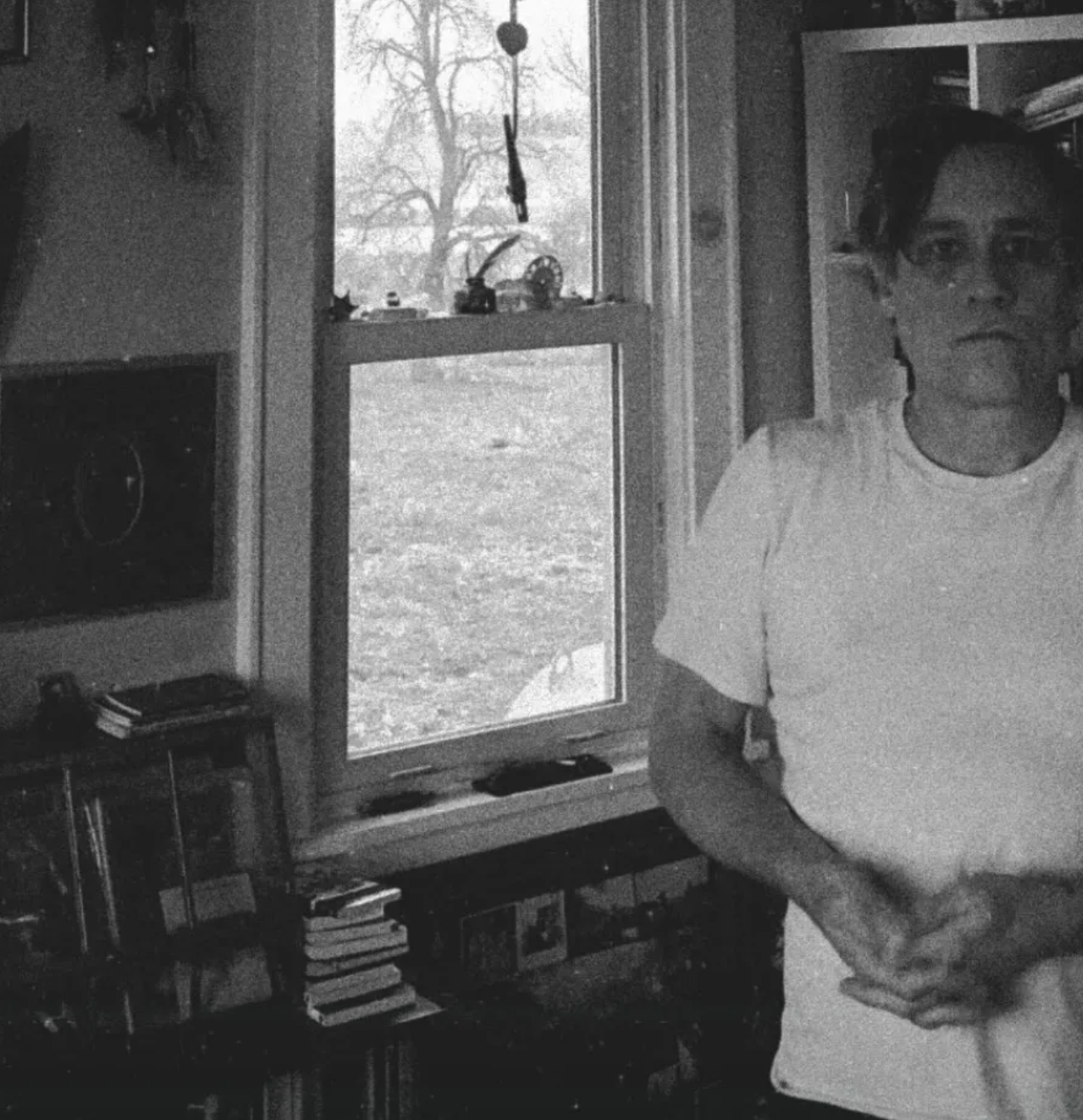
Author photo Adam Gnade from https://adamgnade.com/.
I had the luxury of meeting my favorite author quite accidentally. In 2017, while on tour promoting his book, Adam Gnade (pronounced GUH-NAH-DEE) ended up crashing at my house. He chose to sleep in the room where I kept a painting I’d found abandoned by a dumpster at my local Trader Joe’s. The beautiful portrait of an unknown woman I was convinced was haunted. My convictions of possessions did not deter Adam from finding repose there. Luckily he lived.
As thanks for the accommodations, Adam gave me a copy of Caveworld, a novel in his We Live Nowhere and Know No One series which also includes several audio recordings of writing backed by noisy folk music (self-described as "talking songs"), along with a small non-fiction book called The DIY Guide to Fighting the Big Motherfuckin' Sad, which has been an indie bestseller for years, offering inspiration to anyone trying to survive in these hostile times.
After finishing Caveworld, meeting all the fictionalized versions of real people from Adam’s life, I was stopped in my tracks. Writing could be punk rock, you didn’t have to be some elite from somewhere stupendous. Like music, you could just do it. Not long after Adam wrote Float Me Away, Floodwaters, a novel about life on the road and life at his farm in Kansas, he decided he would set out to write a new book every year and tour as much as he could. In 2025 he released Your Friends Will Carry You Home, his sixth book in as many years.
In October of 2025 I sat down with him, his godson Jack, and my friend Billy at Vegos Restaurant in Albuquerque, New Mexico.
This interview was edited for clarity and brevity.
m.e. gamlem: You brought your godson along on this trip. I was thinking about how a lot of your books are about your travels and traveling. And I was thinking about how that was kind of your legacy. And bringing your godson was part of your writing legacy.
Adam Gnade: What happened was I was driving around Kansas, getting ready to leave, and I was listening to Paul Simon's Graceland, and there's a line in the song “Graceland” where he sings, “My traveling companion is nine years old. He's a child of my first marriage. I have reason to believe we both will be received in Graceland.” And I was like, we're going to go travel somewhere. We're going to go and see what happens. It just felt like the right thing to do, and we just did it. And now we're here.
m.e.g: Yeah. That's awesome. It also struck me, you've talked a little bit in some of your books about the American experience. I was struck because taking those kinds of trips are a lost art for Americans.
AG: Yeah. I think. I don't know if in the Internet era people are as curious about the country.
We're in a time when we mostly just hear bad things about the United States, and it's easy to not love this country. And we have so many reasons not to, whether it's our history of genocide with Native people or the way that the administration is gutting democracy now. But I think it's important to realize this country does have a lot of great things, and mostly by that I mean the people and the land. And I think it's important to see the place that you're in and to remember that despite the legacy of brutality, it's a good place, and most people are pretty good. And I think in this era, we tend to isolate ourselves and we start thinking negatively about our fellow citizens. And I think when you do that, I think that's when you need to get out into the world and be around people and be reminded of what people are actually like.
I generally have a pretty fond feeling towards most people that I meet. And there's some bad ones out there, of course, but it's good to be reminded that they're not all bad. If you're stuck, if you're piling on all this negativity of what the world is like, you're not going to be in any shape to change it or to fix anything or to remedy the damage that's been done. You have to love a thing to save it, or you have to love a people to care about them. You've got to love the land to be a steward of it. And you need to be reminded of those things. And one of the ways you're reminded of those things is to be thrown back into it on a regular basis.
m.e.g: One of the things I love about reading your books is that reminder. Most of the times when I've been on the road, most of the places that I've been, I am reminded, ‘there are a lot of people out here just trying to make an honest life and an honest living’. And especially in the small towns that are on the highway and along the way and waiting. Do you think that contrast between the bad and the good is amplified when you travel?
AG: I think the contrast is amplified when I'm at home and I'm not seeing the country. I think when I'm out seeing the world, it smooths out into a more realistic portrait of what is actually going on, that it's not black and white. It's not good versus evil. It's more of an organic experience.
m.e.g: We happen to be at Vegos, where we were last time, where you totally killed two entrees, which is one of my favorite things to remember. But one of the things that I loved about that and loved being here is that you wrote an entire book (After Tonight, Everything Will Be Different) where the motif was food. How does food work in with the overall narrative that you're telling in your books? Because it doesn't just come up in that one.
AG: There's quite a lot of food in all my books. When I'm reading books, I think there's a lot of things that are left out of fiction and a lot of things that are left out of literary works where there's things that people do that you don't see much in books. Like when I'm around people, people sing a lot. They sing songs that they like or they make up silly songs and they sing in the shower or they sing to their pets and stuff. You don't see that in books very much. And that's the thing, that's the experience of what we do. We spend a lot of time eating. We spend a lot of time thinking about food.
Food is survival and sustenance. It's also pleasure and it's reward. I don't want to like point anybody out, but you can read a whole novel by so and so writer and the characters never eat, they never go to the bathroom and they never like.. not that I want to write like toilet scenes, [but] that's just a huge part of who we are and what we do. We do it many times a day. And I think I'm also just really food-centric. I think about food all the time. I like … I'm like thinking about what to make for dinner when I finish the next dinner.
And like I also come from a food family. My parents are in the restaurant business. I love M.F.K. Fisher's The Gastronomical Me. I think it's one of the finest books ever written in the English language. I think everyone should read that for their understanding of the human condition. I also read Anthony Bourdain's books when I was really young, before he had shows. I mean he might have had shows at that point. I don't know. Kitchen Confidential might be pre-show. I picked up one of them because he looked so cool on the cover. And I was like, this guy seems like somebody that I'd want to be friends with, but he's like a dad, you know, I [was] only 20, and I just kind of like fell in love with Anthony Bourdain and his literary works which were all connected to food when I ever first started writing.
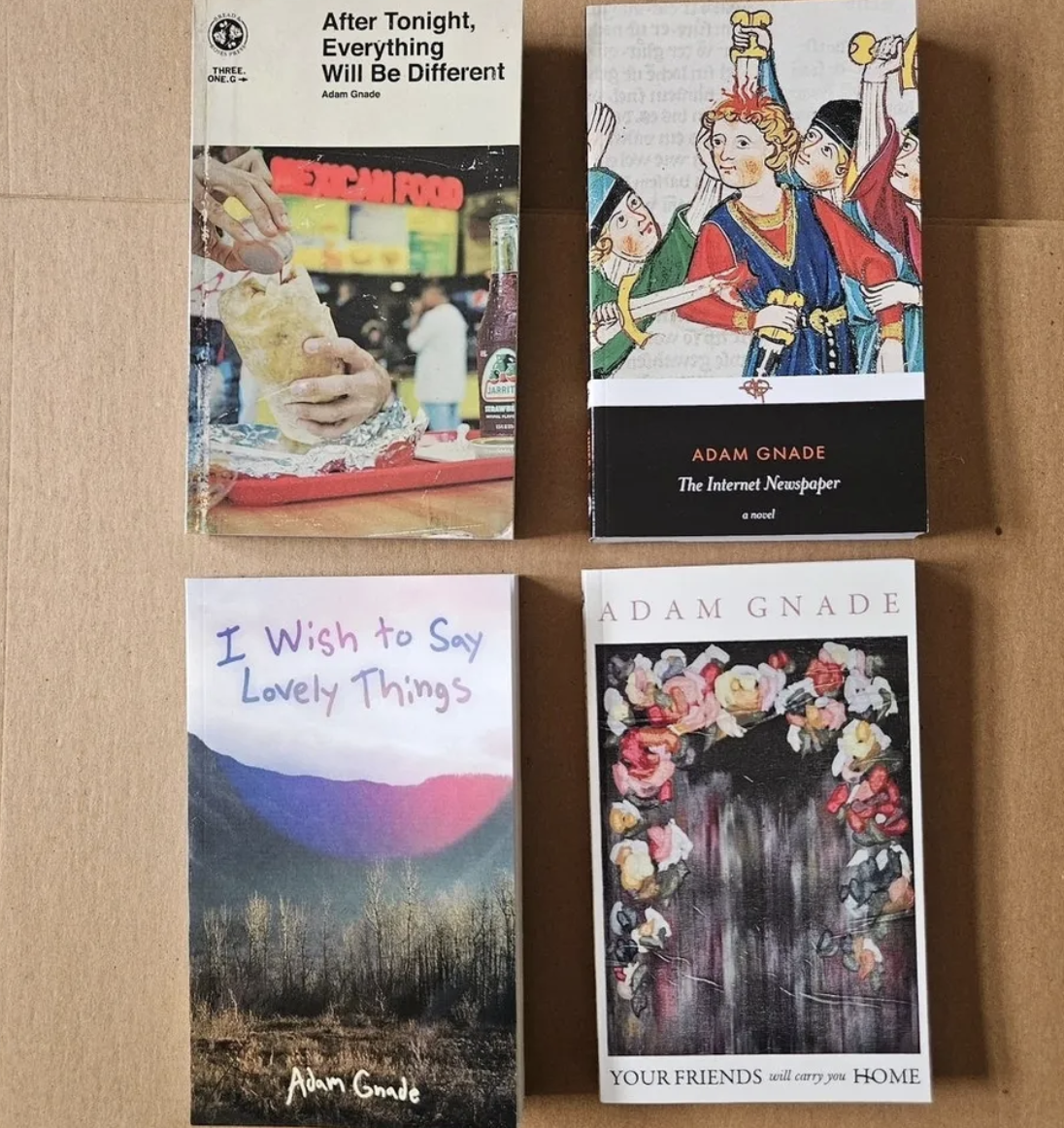
Collection of Adam Gnade’s works. Photo from https://adamgnade.com/
m.e.g: And you live on a farm. So you’re growing your own food. A lot of it. How has that experience informed you as you’ve gotten older? You’ve only explored your farm life a little in your writing, but that relation to food must translate into your writing.
AG: I think it informs less food than it informs lifestyle. Because I grew up between three houses as a kid. One was at the beach in San Diego. One was up in Northern California in the strawberry and artichoke fields. And the other one was in La Veta, Colorado. My grandparents had a farm, so I spent a lot of time between those three in very rural situations and loving that kind of life. And I've been trying to become my grandpa for my entire life. Or my grandma. Either one. They're both such fundamental figures to me, and they were country people that treated you kind and that were intelligent and also very country, you know, guns and fishing and the whole … trucks and everything like that. But not what some city people might think of.
Chasing that experience my entire life and trying to refine my life, maybe before even thinking about it, trying to go back to the farm, basically. Basically kind of like trying to return to this original thing that I fell in love with as a toddler.
m.e.g: You also grew up in San Diego, especially at a time where the punk scene was exploding and you were getting the DIY punk kind of ethos that you still certainly live by. How have you found the balance between those two experiences? Or are they actually the opposite or are they intrinsically similar?
AG: The punk side and the coming from an art scene is so deeply ingrained in who I am. And with the farm side, I have a hard time separating them out or knowing where one begins and where the other one ends.
Our farm is kind of like a punk house. Not in the ratty sense where, you know, it smells like cat piss all the time. But if you were to walk into the house, you would feel like our house could exist in Golden Hill, the neighborhood that I grew up in in San Diego. There's just so much crossover.
And I'm still very much a part of a punk scene, both at home in San Diego and where I now live in Kansas. There's my publisher, Jessie Duke, who is Jack my godson's mom. She runs a venue out there, a community center. There's hardcore shows every week and there's Food Not Bombs. And it's in the middle of Lawrence, Kansas, which is not exactly a cosmopolitan place. We are very much in punk rock, maybe more than I've ever been in my life now, which is crazy to think, like, you're more in a community now as an adult than I was as a teenager.
m.e.g: Do you think the experience in San Diego has helped you in Lawrence, Kansas?
AG: Yeah, absolutely. Because one of the things that everyone that's involved … well, Jessie and myself and my partner Elizabeth … we went to the Che Cafe in San Diego, that was where we saw shows, and as soon as Jessie took the directorship of this venue, she realized that this could be like what we had then for kids that are coming now. So the kids that are coming to the hardcore shows are all 18 to 21. They're super young, but they're getting that sort of same experience. And that's partially because we are trying to make it like that. There's a bookstore in the space. You know, there's Palestine flags on the wall. There's trans flags on the wall. It's a very curated space to be … a good, safe place for people to be … to be nourishing and fundamental for them growing up as it was … as our places were to us.
m.e.g: I grew up in Washington, D.C. right and we had all this access. [D.C. and San Diego are] epicenters of capital and government and culture. Even in the ‘90s, that was still kind of rare. So now you have this opportunity to continue to translate what you know into a place where that might not have existed before.
AG: That was one of the things about San Diego when we left. We were like, San Diego doesn't need us. San Diego's doing great. But, yeah, Kansas needs more of that type of stuff.
One of the things that's been interesting about traveling this summer, I've stayed with a lot of friends and also just met new people. I wanted to see what people are doing right now … to see what people are doing to resist what's happening with the administration, what they're doing to survive, what they're doing to keep their communities healthy. And almost every person that I talk to about this has said, in my town, there's a new hardcore scene and it's all teenagers. You throw a show, there's going to be two-three hundred kids at that, and they're all going to be, like, super into it.
When I talked to my friend in Bloomington, she was like, it's bigger than the folk punk scene ever was. The folk punk scene was always really small, and there weren't a lot of people, like, in the actual town. But now there's just this big thing. Indianapolis, the same thing.
m.e.g: Billy and I, when we were in a band together here, we played for what, like 20 people? And it was always the same faces. But now with the kids, there's way more bands than there were, even just ten years ago. That it’s happening in places where maybe it wasn’t traditionally happening before gives me a little sense like you passed on something important.
AG: I don't know why it's happening. A couple people I talked to were like, we think these are kids that grew up in Covid and were not allowed to do anything and suddenly you get to the point when you're 17, 18, and your parents are like, ‘okay, you can do things now’. The people that I’ve talked to are of the opinion that these kids are kind of like freed up to do whatever they want and they're going for it. That's all because they were held back for so long and now they have enough freedom. You're 18, you can do whatever you want. Or you're 19, you're out of the house and they're just doing shit. Yeah, it's beautiful.
m.e.g: For those that aren't like in the know about your writing, you kind of write about your life, but every book that you write is not like a diary or structured the same. It's not just a retelling of what you did day by day. But you always have like a theme or scene or settings or something. How do you decide, year to year, what's going to be the thread through the book?
AG: It's mostly reactional, per title. For instance, when After Tonight, Everything Will Be Different came out, it's kind of like short, fragmentary stories, mostly from the past, but it's like a lot of different stories covering a lot of ground, and then for The Internet Newspaper, I wanted to make it different, so it's three days. Yeah, it's three days in this story. And I wanted it to be almost like a play. So when I wrote that, it's about three days that actually happened in October, actually this week, it's this week of the year 2000. And so I went to San Diego this week in the year 2022 to write it. I'm trying to do the math here. And on those days … so the chapter that takes place on the 5th of October, I wrote on the 5th of October in the locations. So I went to the locations that I'm writing about in each of those stories. And I stayed in those locations for the amount of time that I would have stayed in them in the story and wrote while I was there to capture the weather and to capture the time of day, where the sun is, what the smells are like. And sometimes the places weren't there, so it was a parking lot. But often it was like, outside of the Che Cafe or at Black’s Beach, on the cliff at Black’s Beach. And I went there and stayed for 12 hours for those scenes. It's almost like, I don't know, maybe that's like method acting.
m.e.g: Yeah. So I was gonna say it's very immersive writing in that. In that way that you're actually taking yourself back to the place rather than just relying on memory.
AG: And that's just one very short piece. And then the next one is like, almost like an entire timeline in I Wish to Say Lovely Things, which covers 20 years. It’s a timeline of what happened during those 20 years. You can kind of use it as a key to decode the rest of the books and meet all the characters around there. That one is about dealing with the death of a friend. And sometimes when you're dealing with grief, you kind of, like, take your life apart and in your mind list out where you've been and what you've done and the moments you've had with everybody that you knew.
So [I Wish to Say] begins with the death of my friend. And then it's me thinking about all those times over those 20 years. Then it comes back to that. Headed towards his funeral. And the book after that [Your Friends Will Carry You Home] is set in England. They're all the same characters, really. New characters get added all the time, and sometimes characters die and they're gone, or I lose track of people, like anybody loses track of people. And that one was just a couple weeks in England. And it took place basically right after I Wish to Say Lovely Things ends.
Then the book that I finished this summer takes place right after that fourth book, Your Friends Will Carry You Home, ends. So I'm getting closer in time right now where I'm almost writing them as they happen, basically.
I don't think it's memoir in the sense that it's being written as it happens. And that one is more of a novelistic structure with a lot of physical action, dialogue.
m.e.g: One thing that really drew me to your work was I would read one novel or listen to a record and then learn something else in another book that would totally enhance the context. Or sometimes you learn another part of the story, but it’s never in a linear fashion. So, every time I pick up one of your books, I wonder what characters might be coming back? Or, what am I going to learn, where am I going to be taken? Even though I know it's autobiographical. What do you call your work?
AG: Well, I mean, it's autobiographical. I just call them novels. Just because I use a lot of structure … like, the structures of fiction. I use scene settings and I use dialogue, and I try to write it in, like, a fictional standpoint, but it is really just autobiographical. And I just change the names of the characters.
They are becoming more linear in the sense that I'm writing them as they're happening. Whereas the recordings can jump around in time and sometimes they have nothing to do with time. And they're more about philosophy, the philosophy of … they're more about ideas.
m.e.g: They definitely inform each other. As somebody who's beginning to take my own writing a lot more seriously and thinking about not just telling stories, but how I want to tell stories, I've come back to the idea that I can revisit characters in different contexts or different places in their life to say something else philosophically.
AG: I'm using Proust’s model. Basically … I didn't know it at first because I hadn't read Proust and when I first decided to connect the records to the books … it was before there were any books … and I was writing these records, and I knew that I was going to write a book but I just didn't know how, I didn't have the ability to do it, but I knew that they were going to be connected. And what I was thinking is it'd be something like Faulkner. But it's a lot more like Proust, where it's following a person's life or somebody like Karl Ove Knausgård, his My Struggle series. It's closer to something like that because at the center of it is a personal experience. Some of the books aren't written from my perspective, but they're written from the perspective of, like … Caveworld is meant to be a story told to me by the character Joey Carr. And it's explained … that book is explained in I Wish to Say Lovely Things, I think where it's talking about sitting down with Joey Carr while he's on speed for days, while he tells the story of his family. It's a family story. It’s a family story that's, like, largely inspired by East of Eden by Steinbeck, which I didn't realize until I reread all my books last year, because I have to keep track of, like, what I said when I said it, and make sure that I'm not telling the same stories over and over again, and I reread Caveworld right after I reread East of Eden, and I was like, I totally get I was inspired by East of Eden. There's, like, a lot of not ripping it off, but there's some, like, big similarities in the sense that there's epistolary things and there's letters written back and forth between the brothers. There's brothers. And it's a family saga and a tragedy. It's a tragedy. I don't want to blow the ending for people, but it is a tragedy.
m.e.g: When I got to that scene with Joey Carr, like, being strung out. I was like, oh, this explains everything.
AG: Like, the biggest Easter egg.
m.e.g: It was so satisfying. Like, honestly, it was so satisfying because even though Joey Carr had shown up a couple different times in different stories, I wasn’t really expecting him to return. But you provide this satisfaction or another layer that I find so fascinating.
But that brings me to my next question. When you're promoting your books you put, like, modern writers and classic writers together as a base of comparison and you seem to have a balance of both. What’s the importance of having references to contemporary and classic writers for you?
AG: Yeah. I mean, it's so important to read both because there's so much you need to learn from classic writing. But you need to know what your people think and how we tell our stories now, because you don't want to write like Proust. If nobody wants to read Proust … I mean, people want to read Proust, but they don't want somebody writing like Proust now. It's not necessary.
It's just like going out and seeing the country. You want to know what your people are doing and what they're thinking and what they love and what they hate, what they're afraid of. It’s very satisfying being involved in literature because you've got this whole wall of ghosts behind you that you can visit all the time, and one day you'll be one of them. You're adding to this tradition of these things that have been said. Almost like you're in a band with them. To take somebody like Proust and to be like, you know, we're doing a very similar thing. We never knew each other. We couldn't have ever known each other. But we're kind of friends in a certain sense.
Then there's people in the future that are gonna be doing the same thing, and there's people you'll never know that are doing the same thing. I just love being a part of the tradition of literature. It's very satisfying.
I think that's probably like what somebody who's like, like a blues musician probably feels that way about the blues or somebody who's, who's an abstract painter, they maybe feel the same way about Jackson Pollock and it's comforting to be in that world and to know you're in that world. It's satisfying to go back and read every day of your life for the rest of your life and never even touch the wonderfulness of books that are … that have been published.
m.e.g: Oh yeah, we definitely won't. I'm buying books out of pace that like far exceeds how much I can read. Every time I set foot in a bookstore, I'm just like, oh, how much money, like am I gonna spend?
I think one of the reasons I decided now to like focus on my writing is how do I want to be part of that conversation and leave something behind in that manner. As you were talking, I was thinking about like what I learned from punk rock, right. You pass the knowledge on. I saw all these other people do it and hopefully people see me do it and they feel they can do it too.
I want to make writing very accessible. Especially because I feel like right now like people don't want to like access literature and I don't know, I mean, maybe that's me.
AG: I don't think people want to do a lot of things. I think everybody's so stressed out and scared, and especially for the last year, I think everybody's just trying to survive and [they’re] like afraid of what's gonna happen next. And rightly so, because terrible things are happening everywhere. You know, buildings are being raided and children are dragged out and zip-tied and bombs are falling right now in Gaza and innocent people that could be your … could be your new … the best friend you've ever met in your life are being annihilated.
Other writers, poets, they're over there and they're losing their lives right now. And we're living in a very increasingly brutal time. But it's important, though, to keep finding those things because we need reasons. We need reasons to live. We need reasons to be hopeful. We need reasons to feel empathy, especially as, like, part of a lot of our country is turning…
m.e.g: Turning against empathy.
AG: As, you know, they're calling empathy a disease.
m.e.g: And you know, it was something that, for me, I really needed to hear. Especially with trying to understand what right do I have to be an artist when the world is falling apart? Like, what role does this actually play? And what can we actually talk or write about because writing is empathy. I think all, you know, stories matter because that's exactly what they do is they show us empathy. It gets back to what you were saying at the beginning, why is it important to travel and see people to actually see the human being rather than, like, the stereotype or whatever.
AG: I've noticed a lot more people reading poetry lately and taking comfort from it. I'm more brave when I see other people being brave. And I've taken a lot of strength from artists that are standing up for what they believe in now and saying, I'm not afraid of losing this. Like, say, Sally Rooney, who is…
m.e.g: Got to read her. I keep hearing her name. I have one of her books.
AG: I love her. I love her writing. I don't know what the state of it is now, but she was being threatened with terrorist charges for saying that she supported Palestine Action, but she's also doubling down on it and saying, like, well, I'm giving all the money from this TV show that's been made about my books to these causes. Seeing her be brave about that and seeing her being like, I'm just an artist … and her books aren't political … they're just about people … seeing her say those things makes me feel stronger. Makes me not want to hide my … my beliefs.
m.e.g: I think that's important. What I'm coming to reckon with is I want to write. I shied away from wanting to write queer stories because I just don't want to be pigeonholed. But at a certain point, especially recently, the dam just broke open and I … I can't not do it. Because it's important. It's important.
AG: It's important to others that you're doing it.
m.e.g: And again, I'm thinking about that generation coming up behind and I want them to have something that creates resilience for them, that they can hold on to.
I only have one more question that pops into my head that has nothing to do with writing at all. You posted recently that you bought a skateboard at age 40, whatever that we are, and your godson's like skating. Talk to me a little bit about skateboarding, what skateboarding means. This is totally a just for me question.
AG: This is very important to me too. So I've always wanted to be a skater and … I've always been afraid of it. And … and it's been one of my dreams to skate and I've always been afraid of being hurt. I've always been afraid that I wouldn't be able to do it. I would skate down the street as a kid and like, go to 7-Eleven and I've always had these dreams and I keep having dreams to this day where I'm riding my skateboard to 7-Eleven and all of a sudden I figure out how to do something and then I'm like, going up a wall or I'm doing something that feels incredible. It's like they're flying dreams, basically.
I've always just thought about skateboarding as, like, the sport of what, royalty. It's a beautiful thing and it's like the most democratic thing in the world. Anyone can get a skateboard for almost nothing. And then Jack wanted to get a skateboard for his birthday, and I took him to the skate shop and bought a board and skate pads and a copy of Thrasher magazine. And then he went away and he skated when he was visiting … his dad sent him to skate camp and he came back and told me I should get a skateboard and skate with him. And I was like, no, I'm gonna hurt myself. And then I was like, ‘you're asking me to skate with you.’ Then the next day, we went and I got a skateboard. And we've been going to skate parks almost every day. And we're just … we skate bowls and ramps and I can actually do it … and if I can make it … I can do the things that I want to do … and I'm very surprised. It all feels like I'm dreaming. A lot of times … I'm not a great skater at all, but every time I'm on the side of a ramp up like this, not that I'm trying to brag about being good or anything, because I'm not, but like, it feels so incredible. I feel like I'm dreaming.
I feel [like I’m] a part of the culture of skateboarding which feels like being a part of the culture of literature or of punk rock. It feels really good. We go to the skate park, we see the same people a lot of times, and everybody's friendly and nice. I feel really good being a part of skateboarding, and I'm very excited to do it every time. We have our skateboards in the back of the car right now. We're always looking for chances to skate. And I think it's really kind of like, saved me from a lot of dark thoughts and depression and things like that, because I've kind of had a bit of a rough year and I keep going back into sort of hopelessness, and I keep defaulting to, like, this hopelessness I haven't felt since my 20s. But there are certain things that are pulling me out of it. One of them is skateboarding. And when we come back from skateboarding, I immediately feel more hopeful about the world. I feel more loving. I feel more connected to the Earth. I feel less worried.
Adam Gnade’s work can be found at his website https://adamgnade.com/