
Writing reclamation
During my August residency in Lake Tahoe, I meet Jodie. Both of us are pursuing an MFA at the University of Nevada-Reno through the Low Residency program; I’m in the fictional track and she’s in poetry. We’re similar: same age, married, kids. We trade mom and husband stories–the decision of when to give ourselves to family and when to drive a stake in the ground to claim our own pursuits. Mental load bleeds between the two when external calls come in during residency: “I don’t know how!” and “You’re the only one that knows!” Our answers are similar too: “You figure it out.” and “Our family is not a cult.”
After residency, Jodie texts to ask if I’ll join her in Portland for a country music concert followed by the Portland Book Festival. Yes! Then, she asks me if I’ve read The Artist’s Way, “I don’t know what your growth process has been and don’t mean to assume anything, but for myself, poetry has been as much about reclaiming myself, as writing. What do you think?”
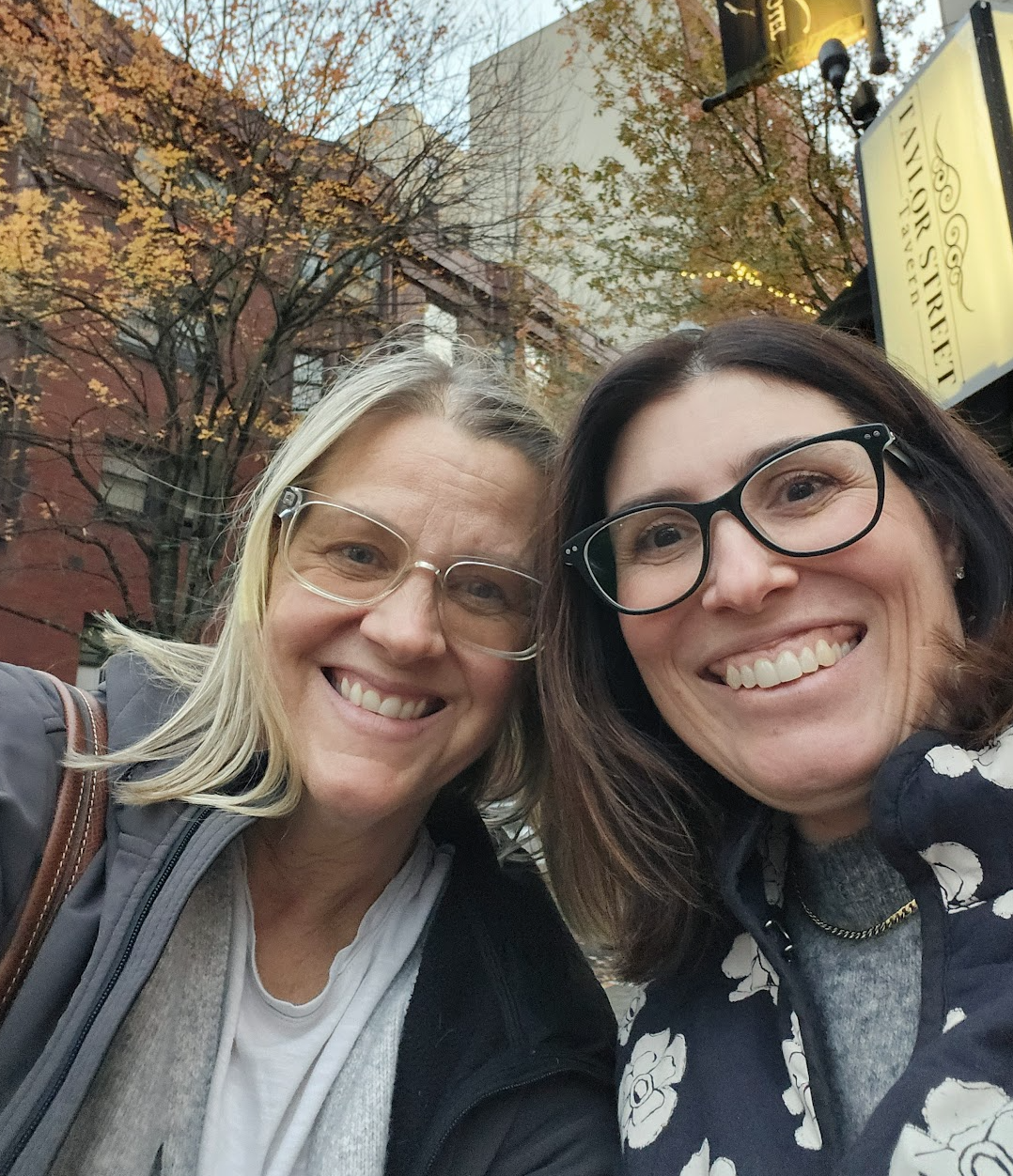
Heather McCurdy (left) and Jodie Sneller (right) at the Portland Book Festival.
There is no need to clarify the question. I know Jodie’s question has two layers: Can you reclaim your identity–as a mom–to pursue a higher calling and rehabilitate fractured self-acceptance?
As moms, it’s assumed we will drop everything in service of the family. Do the dishes. Find socks. Where are the keys? The ask almost always comes before the try. When Jodie says “poetry is about reclaiming herself,” I can safely assume she’s speaking to the reclamation of time for women–especially moms–to decide between doing everything, delaying, or delegating family-work. And frankly, delay and delegation are key to finding the necessary time to pursue a Master’s degree.
Even in 2025, societal zeitgeist declares that if a woman wants to have it all, she must do it all as well. This zeitgeist is so strong that young women are refusing to marry in record numbers. Jodie and I–having talked about the choice of marriage at residency–recognize that as women, the privilege to pursue a degree honors the women before us who have suffered and died in order to allow us to vote (1919), attend college (Title IX 60’s and 70’s), have a credit card (1973), and sign a lease (1974).
In her question, Jodie also says, “I don’t mean to assume anything….” What she means to do is respect my family structure. Dynamics can vary based on politics, economics, and religious values. And her question supports the crux of Jodie’s question: Can my family share household responsibilities so I can individually pursue something deeply meaningful to me? Healthy relationships require finesse. I am not demanding my own time, our relationship isn’t built that way. My spouse supports my endeavors and I support his. As capable adults and tweens, I have faith that my family will survive my weekend absence, and even thrive while I am gone.
When Jodie asks me where I am in “my growth process,” she’s asking more of a core question that speaks to my personal growth as a human. It’s a nicer, subtler way of asking: How much therapy have you been in? Do you read self-help books? Have you handled your life’s trauma? It’s complicated. As a pilgrim of Santiago de Compostela, I walked five hundred miles across Spain to find answers. The question of personal growth–to reclaim oneself, to find answers–is a relentless journey with no end. Writing fiction and being in a Master’s program is a commitment to staying on the path of finding answers.
Friday, November 7th, I hit the road with a bag of week-old Halloween candy and an eclectic play-list. Four hours later, I’m driving down I-5 into Portland. Graffiti covers the cement walls built to protect residents from noise pollution. Mary Beard, a renowned classicist from Cambridge says, “graffiti provides insight into daily life.” She meant Pompeii, but it has the same purpose in 79 A.D. as today. Reclaiming power. All it takes is someone with bravado and a message.
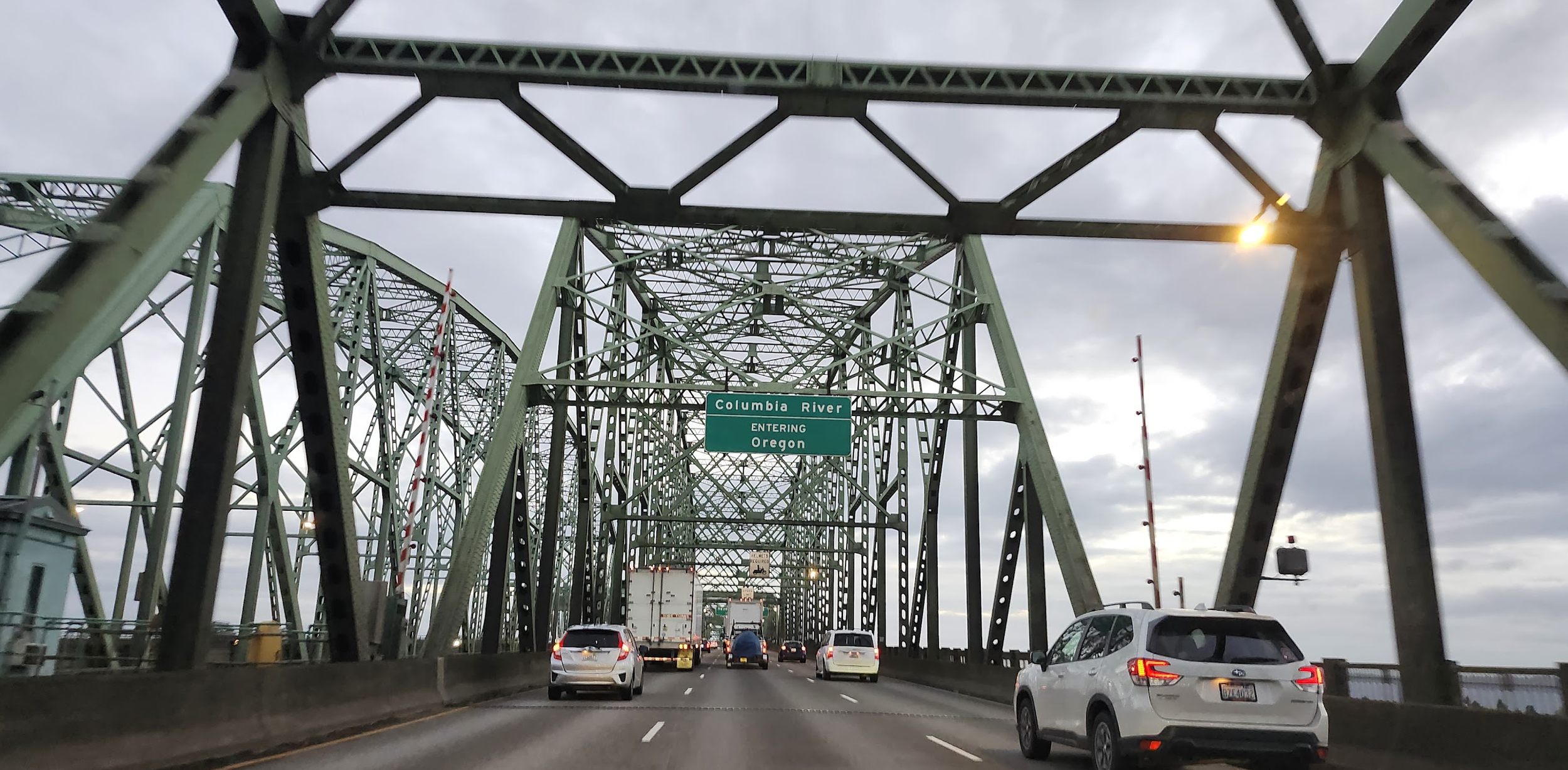
And suddenly—crossing a bridge—my GPS declares I’m in Oregon. At the hotel, I text Jodie, get my room, and unpack. We uber to Koji Osakaya, a Japanese restaurant with pleather-covered seats and a Hello Kitty neon sign. Jodie orders a double tuna roll and I get the dragon roll. Then, we talk about the program and the mentors. The conversation steers towards the question from our residency a month ago, “What are we reclaiming?” and “Why do we write?”
This generic question is short-hand for: Craft is hard work, takes time, and if I’m not making bank, is it worth it? Why am I giving up family time to pursue a Masters? Do fathers ask themselves questions like mothers? Between a Sushi roll and Sapporo, neither of us have a straight answer. We quote passages from books we’ve read: Cameron’s The Artists Way, Gilbert’s Big Magic and Kabat-Zinn’s Wherever You Go, There You Are. We agree the world needs more introspection, more art, more critical thinking, more attempts to make sense of the world in ways that are difficult.
The difficulty we address, at least in this restaurant, is the difficulty of time needed to examine in quiet, alone spaces. And why is this important? In a world of 15 second reels, we’re not given adequate time to unpack thorny issues, listen to other viewpoints. And why does time matter? Because diplomacy,relationships, and compromise don’t thrive in expediency.
After dinner, we walk to the Wonder Ballroom. Inside, the opening act has the audience warmed up. Country music feels like home to me. It’s the background music of my memories: I’m swing dancing with Grandpa at the Elk’s Club, singing Dolly’s hit 9 to 5 at the top of my lungs, in college, doing tequila shots to Shania’s That Don’t Impress Me Much.
In front of me stands a Portland Cowgirl: horseshoe gages in her lobes, a tailored country shirt with silver-snap buttons, a creamy prairie skirt, and bright red Justin boots. In writing, the Western genre is about individual freedom and the clash between civilization and the wild “uncivilized.” And Portland’s women are showing me exactly how free they are.

The lights go down. Margo steps into the spotlight. She has Rapunzel hair: “let down your hair.” Girl. Don’t worry. We will. Margo’s music is a mix of Reba and Dolly rolled up with Evanescence and Nina Simone. I’m reminded why I love country music: the women.
They are pragmatic, sentimental, and hard-headed. After the concert, Jodie and I Uber to my hotel. I pour prosecco and we talk about husbands and children, friends and old loves. We’re intrigued by the difficult process of transposing complicated ideas to poetry and narrative. The why of writing. The time to do it. The decision to change family and female narratives. By midnight, she heads home and it’s lights out.
Saturday morning, at PBF, the events will take place in six different buildings surrounding a small park: a museum, a meeting hall, a church, and a concert hall. Two hundred people (mostly women) line up to hear fantasy writer Rebecca Yarros speak in the Arlene Schnitzer Concert Hall. In the nosebleed section, next to me, a middle-aged woman wipes away a few tears while her friend consoles.
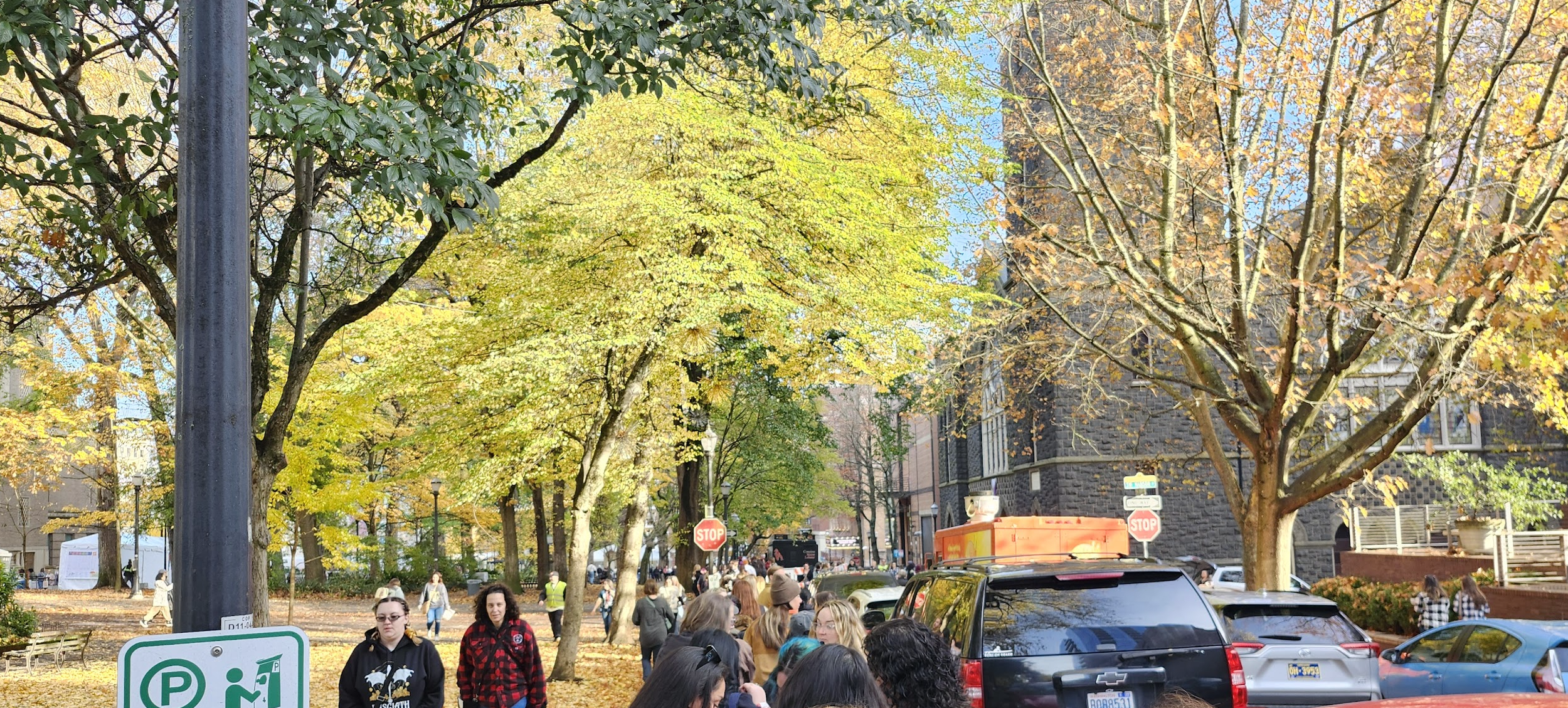
Snapshot of a busy Portland street outside the book festival. Photo by Heather McCurdy.
I enjoyed Fourth Wing, it’s a story about a young girl who is forced to train dragons, despite being frail. Violet is clever with strategy, and in the end, gets her dragon. To me, it was a fun story–youthful, energetic. It’s just a story. But I take the time to see the middle-aged woman as someone who was inexplicably changed and possibly healed because of this book. I see her differently. She has reclaimed something. The specificity of why she is crying no longer matters.
After the talk, I cross the street to the Portland Art Museum to catch a pop-up of Gabriel Urza. His book Silver State is a political thriller about a young public defender who is forced to re-examine a death penalty case he handled. Behind him five different busts gaze over his shoulder. The expressions chiseled into their faces seem intrigued, dismissive, but unable to turn away. To hear justice described in front of art commissioned by wealthy patrons is indeed interesting.
I meet Jodie for the Stacey Abrams event to promote her book Coded Justice. Abrams speaks to the difficulty of being taken seriously as a professional while being an author. She wants to help people understand the complexities of the real world. Her new book is about a former Supreme Court clerk investigating a high-tech company whose AI powered medical systems are experiencing dangerous malfunctions.
It’s a timely subject as tech companies have culled tens of thousands of jobs due to AI, the recent murder of a healthcare CEO, and the problematic lack of political legislation regarding technology. “What can we do,” Abrams wonders aloud, “when we’re in a position of responsibility but not authority?” Turns out, quite a lot when we shift from philosophy to action.
After Abrams, we walk to The Old Church where Lidia Yuknovitch (a UNR mentor) and Melissa Febos will speak. Their words—in a church—is the art of a spiritual experience sanctified by excavating memories with writing. A choked-up audience member tries to ask a question. Febos interprets, “When we can’t express trauma, how do we write it?” Yuknavitch advises one to write around it in the pattern of a circle, outside the hurt: note colors, sensations. I think of a Fibonacci Shell. Continuing to write, to express, to stay on the journey, it gets darker and infinitely cramped, but once there? You can hear the whole ocean.Powerful stuff—because the act of writing allows a person to grow, to heal. Reclaiming one’s self.
After the festival, we meet for our last dinner. With smiles and hugs, we promise to meet again next year. She goes one way, I go another. I will drive home and continue to protect my time. To honor the process of reclamation, I will think. And I will write. And so will she.
“This generic question is short-hand for: Craft is hard work, takes time, and if I’m not making bank, is it worth it? Why am I giving up family time to pursue a Masters? Do fathers ask themselves questions like mothers? Between a Sushi roll and Sapporo, neither of us have a straight answer.”
